
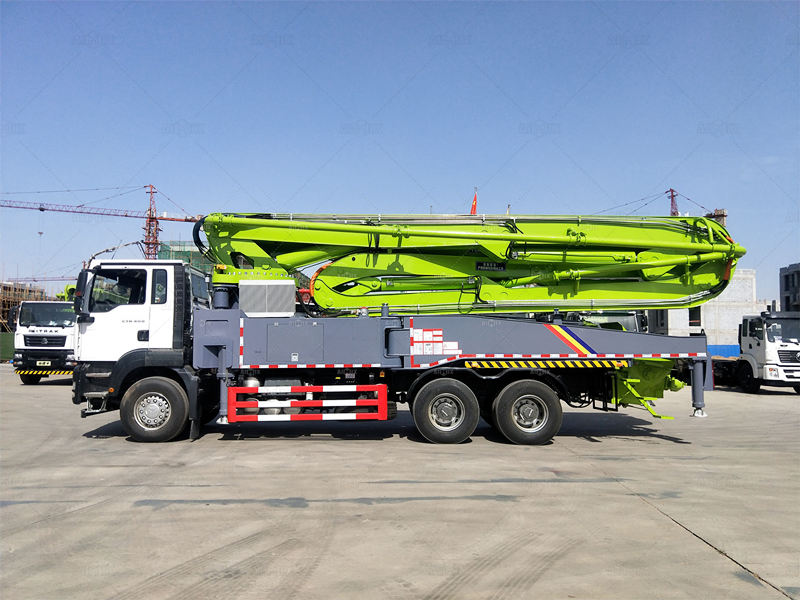
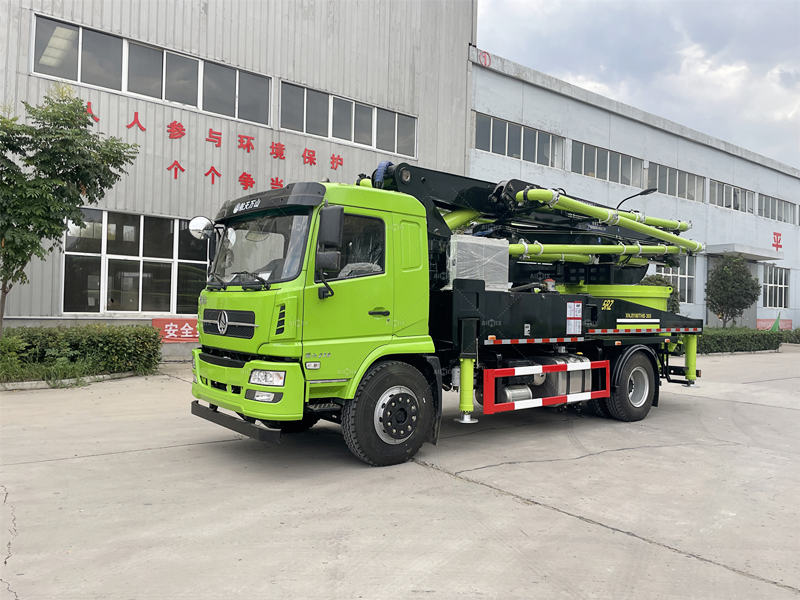
Measuring a construction site accurately is a fundamental step to ensure the safe fit-in and operation of a mini mobile concrete boom pump truck, a versatile piece of equipment that combines the mobility of a mobile concrete pump for sale with the precision of a concrete boom pump truck, while being more compact than standard models. Unlike bulkier concrete boom pump truck units or stationary alternatives, the mini mobile concrete boom pump truck balances maneuverability and performance, making it ideal for small to medium construction sites—such as residential renovations, rural infrastructure, and urban infill projects—where space is often limited. However, even with its compact design, improper site measurement can lead to equipment damage, safety hazards, or inability to access key pouring points, disrupting project timelines and increasing costs. This article details a step-by-step guide to measuring construction sites for the safe fit-in of a mini mobile concrete boom pump truck, integrating key phrases like concrete portable pump and mini concrete pump (close counterparts to the mini mobile concrete boom pump truck) to provide comprehensive, actionable insights for contractors and site managers.
Pre-Measurement Preparation: Gather Tools and Understand Equipment Specifications
Before beginning site measurements, thorough preparation is essential to ensure accuracy and efficiency. This stage involves gathering the right tools, familiarizing yourself with the mini mobile concrete boom pump truck’s specifications, and distinguishing it from similar equipment like concrete portable pump and mini concrete pump, as their dimensions and operational requirements differ slightly. A concrete portable pump is typically lighter and more easily moved by hand or small vehicle, while a mini concrete pump may lack the boom functionality of the mini mobile concrete boom pump truck—understanding these differences ensures you measure for the correct equipment.
First, gather essential measurement tools. You will need a laser distance meter (for precise linear measurements), a tape measure (for shorter distances and cross-checks), a spirit level (to assess ground levelness), a measuring wheel (for large-scale site dimensions), a compass (to determine boom swing direction), and a notebook or digital device to record measurements. For complex sites with uneven terrain or obstacles, a drone may be useful to capture aerial views and measure hard-to-reach areas. Additionally, bring a copy of the mini mobile concrete boom pump truck’s technical specifications, including its overall length, width, height, wheelbase, turning radius, boom length, and outrigger spread—this information is critical to ensuring the equipment fits in the designated area and can operate safely.
Second, clarify the mini mobile concrete boom pump truck’s key dimensions. Unlike a standard concrete boom pump truck, which can be 10-15 meters long and 2.5-3 meters wide, a mini mobile concrete boom pump truck is typically 6-8 meters long, 2-2.3 meters wide, and 2.5-3 meters tall, with a boom length of 15-25 meters. Its outrigger spread (the distance between fully extended outriggers) is usually 3-4 meters, which is narrower than standard models but still requires sufficient space to ensure stability. Compare these dimensions to a concrete portable pump (typically 1-2 meters wide and 1.5-2 meters tall) and a mini concrete pump (similar in size to the portable model but with basic pumping capabilities) to avoid confusing measurements. Knowing these specifications helps you set clear measurement benchmarks for the site.
Third, assess the project’s concrete pouring requirements. Determine the key pouring points (e.g., foundations, columns, slabs) and their locations relative to the proposed parking area for the mini mobile concrete boom pump truck. This helps you measure the required boom reach and ensure the truck can position itself to cover all pouring points without repositioning excessively. Additionally, identify any constraints, such as overhead power lines, nearby buildings, or underground utilities, that may affect the truck’s placement and boom operation—these will need to be measured and accounted for during the site assessment.
Step 1: Measure Site Access Routes for Maneuverability
The first critical measurement step is to assess the site’s access routes, ensuring the mini mobile concrete boom pump truck can safely enter, exit, and move around the site. Unlike a concrete portable pump, which can be carried or towed by a small vehicle, the mini mobile concrete boom pump truck is a self-contained vehicle that requires sufficient space to maneuver, including turning, reversing, and parking. Poorly measured access routes can lead to the truck getting stuck, damaging site infrastructure, or being unable to reach the designated operating area.
Start by measuring the width and height of all entry points, including gates, driveways, and narrow passages. The mini mobile concrete boom pump truck typically requires a minimum access width of 2.5 meters (to accommodate its width plus a safety margin of 0.2-0.3 meters) and a minimum height of 3.5 meters (to account for the truck’s height plus overhead clearance for power lines, tree branches, or building overhangs). Use a laser distance meter to measure these dimensions accurately, and note any obstacles (e.g., low-hanging wires, narrow gateposts) that may need to be removed or adjusted. For comparison, a mini concrete pump or concrete portable pump requires a narrower access width (1.5-2 meters) and lower height clearance (2-2.5 meters), but the mini mobile concrete boom pump truck’s larger size demands more precise measurements.
Next, measure the turning radius of the access routes. The mini mobile concrete boom pump truck has a turning radius of 5-7 meters (depending on the model), which is smaller than a standard concrete boom pump truck (8-10 meters) but still requires sufficient space to make sharp turns. Measure the width of roads and turning areas to ensure they can accommodate the truck’s turning radius—if the site has narrow corners or tight turns, you may need to widen the area or adjust the truck’s approach path. Additionally, measure the surface condition of access routes: the ground must be firm enough to support the truck’s weight (typically 8-12 tons) to avoid sinking. Use a spirit level to check for slopes; access routes with a slope greater than 10 degrees may be unsafe for the truck to navigate, as it could tip or lose traction.
Finally, measure the distance from the entry point to the designated operating area. This helps you determine if the truck can reach the site without encountering obstacles and if there is sufficient space to park and position the truck. If the distance is long or the route is complex, mark key waypoints and measure the dimensions at each point to ensure consistent clearance and maneuverability.
Step 2: Measure the Operating Area for Stability and Boom Reach
Once the access routes are confirmed, the next step is to measure the designated operating area where the mini mobile concrete boom pump truck will be parked and operate. This area must be large enough to accommodate the truck’s dimensions, its fully extended outriggers, and the boom’s swing radius, while ensuring stability and safety. Unlike a concrete portable pump or mini concrete pump, which require minimal operating space, the mini mobile concrete boom pump truck’s boom operation demands a clear, unobstructed area to avoid collisions.
First, measure the minimum operating area dimensions. The operating area must be at least 4 meters wide and 8 meters long to accommodate the truck’s length and width, plus space for the outriggers. The outrigger spread (typically 3-4 meters) requires additional space on all sides of the truck—measure the distance from the truck’s center to each outrigger and ensure there is no obstacles (e.g., rocks, trenches, building foundations) within this range. Use a tape measure to mark the outrigger positions and verify that the ground beneath each outrigger is firm and level; if the ground is soft, you may need to measure the depth of the soil and plan to add steel plates or concrete pads to distribute the truck’s weight.
Next, measure the boom swing radius and clearance. The mini mobile concrete boom pump truck’s boom can swing 360 degrees (in most models), so the operating area must be clear of obstacles within the boom’s maximum reach (15-25 meters). Measure the distance from the truck’s parking position to nearby buildings, power lines, trees, and other obstacles to ensure they are outside the boom’s swing radius. For overhead obstacles, measure the height from the ground to the lowest point (e.g., power lines, building overhangs) and ensure it is at least 1 meter higher than the boom’s maximum height (typically 8-10 meters) to avoid electrical hazards or collisions. This is especially critical because the boom’s height is significantly greater than that of a concrete portable pump or mini concrete pump, which rarely exceed 3 meters in height.
Additionally, measure the distance from the truck’s operating position to the concrete pouring points. The boom’s reach must cover all pouring points without the truck needing to reposition, which saves time and reduces safety risks. Use a laser distance meter to measure the straight-line distance from the truck’s center to each pouring point, and ensure it is within the boom’s maximum reach (accounting for a 0.5-meter safety margin). If a pouring point is outside the boom’s reach, you may need to adjust the truck’s parking position or use additional hoses (which should also be measured to ensure they fit within the site).
Step 3: Measure Ground Conditions and Load-Bearing Capacity
Ground conditions and load-bearing capacity are critical factors for the safe fit-in of a mini mobile concrete boom pump truck, as the truck’s weight (8-12 tons) and the dynamic load from boom operation can cause the ground to sink or shift if it is not strong enough. Unlike a concrete portable pump (1-2 tons) or mini concrete pump (2-3 tons), the mini mobile concrete boom pump truck exerts significantly more pressure on the ground, requiring precise measurements to assess load-bearing capacity.
Start by measuring the ground’s levelness. Use a spirit level or laser level to check the operating area for slopes—even a slight slope (more than 5 degrees) can affect the truck’s stability, especially when the boom is extended. If the ground is sloped, measure the slope angle and determine if it can be leveled (e.g., by adding fill dirt or removing soil) to ensure the truck remains horizontal during operation. A level surface is essential for the outriggers to distribute the truck’s weight evenly and prevent tipping.
Next, assess the ground’s load-bearing capacity. The operating area must be able to support at least 1.5 times the truck’s total weight (including the concrete load) to account for dynamic forces during boom operation. To measure this, you can use a soil compaction tester (to check soil density) or consult a geotechnical report if available. For example, compacted gravel or concrete surfaces typically have a load-bearing capacity of 20-30 tons per square meter, which is sufficient for a mini mobile concrete boom pump truck, while soft soil or sand may only support 5-10 tons per square meter, requiring additional support (e.g., steel plates, concrete pads). Measure the area of each outrigger’s footprint (typically 0.5 x 0.5 meters) and calculate the pressure exerted (weight divided by area) to ensure it does not exceed the ground’s load-bearing capacity.
Additionally, measure for underground hazards. Use a utility locator to identify underground cables, pipes, or tanks in the operating area, as the outriggers could damage these if they sink into the ground. Measure the depth of any underground utilities and ensure they are at least 1 meter below the outrigger positions to avoid accidental damage. If underground utilities are present, adjust the operating area or use alternative support methods to protect them.
Step 4: Measure for Obstacles and Safety Clearances
Identifying and measuring obstacles is a critical step to ensure the safe fit-in of a mini mobile concrete boom pump truck, as even small obstacles can cause equipment damage or safety accidents. This involves measuring distances to overhead, ground-level, and nearby obstacles, and ensuring sufficient safety clearances for the truck and its boom.
Overhead obstacles are among the most dangerous, especially power lines. Measure the distance from the operating area to any overhead power lines—local safety regulations typically require a minimum clearance of 5 meters between the boom and power lines (10 meters for high-voltage lines). Use a laser distance meter to measure this clearance accurately; if it is less than the required minimum, you must either adjust the operating area or coordinate with the utility company to temporarily shut down the power. Other overhead obstacles, such as tree branches, building overhangs, or cranes, should also be measured and cleared if they are within the boom’s swing radius.
Ground-level obstacles include rocks, trenches, construction materials, and other equipment. Measure the distance from these obstacles to the truck’s parking position and outrigger locations to ensure they do not interfere with the truck’s setup or operation. For example, trenches or holes within 1 meter of the outriggers can compromise stability, while construction materials piled too close to the truck can block access to the hopper or boom controls. Measure the height of ground-level obstacles (e.g., piles of sand, steel bars) to ensure they do not block the boom’s movement or the operator’s visibility.
Nearby obstacles, such as buildings, walls, or other construction equipment (e.g., cranes, mixers), also require careful measurement. The mini mobile concrete boom pump truck needs at least 1 meter of clearance from nearby structures to allow for boom movement and operator access. Measure the distance from the truck’s operating position to these structures and ensure there is sufficient space for the boom to swing without collision. Additionally, measure the distance between the truck and other equipment (e.g., concrete mixing trucks) to ensure there is enough space for loading concrete into the hopper safely.
Step 5: Verify Measurements and Create a Site Layout Plan
After completing all measurements, the final step is to verify their accuracy and create a detailed site layout plan to guide the mini mobile concrete boom pump truck’s placement and operation. This step ensures that all measurements are consistent, and any potential issues are addressed before the equipment arrives on-site.
First, cross-check all measurements using different tools (e.g., laser distance meter and tape measure) to ensure accuracy. For critical measurements (e.g., access width, boom clearance, load-bearing capacity), take multiple readings and average them to reduce errors. Compare the measurements to the mini mobile concrete boom pump truck’s specifications to confirm that the site can accommodate the equipment—if any measurements fall short (e.g., access width is too narrow, boom clearance is insufficient), adjust the site or equipment selection (e.g., switch to a smaller mini concrete pump or concrete portable pump if the project allows).
Next, create a site layout plan that marks all key measurements, including access routes, operating area, outrigger positions, pouring points, and obstacles. The plan should be drawn to scale and include dimensions for all critical areas, as well as notes on ground conditions, required support (e.g., steel plates), and safety clearances. Share this plan with the truck operator, site foreman, and other team members to ensure everyone is aware of the equipment’s placement and safety requirements. For comparison, if the project were using a concrete portable pump or mini concrete pump, the layout plan would be simpler, with smaller operating areas and fewer clearance requirements, but the mini mobile concrete boom pump truck’s complexity demands a more detailed plan.
Finally, conduct a pre-arrival site inspection to confirm that all measurements are still accurate and that no new obstacles have been added. This inspection should be done 1-2 days before the mini mobile concrete boom pump truck arrives on-site, allowing time to make any last-minute adjustments (e.g., removing obstacles, leveling the ground, or widening access routes). By verifying measurements and creating a clear layout plan, you can ensure the safe fit-in and operation of the equipment, minimizing risks and maximizing efficiency.
In conclusion, measuring a construction site accurately is essential to ensure the safe fit-in of a mini mobile concrete boom pump truck, a versatile equipment that bridges the gap between a standard concrete boom pump truck and smaller options like concrete portable pump and mini concrete pump. By following the step-by-step guide—preparing tools and understanding equipment specs, measuring access routes, operating area, ground conditions, and obstacles, and verifying measurements—contractors can ensure the equipment fits safely, operates efficiently, and avoids costly delays or accidents. Proper site measurement not only protects the mini mobile concrete boom pump truck and site infrastructure but also ensures the safety of workers and the success of the construction project.